Archive
Partner Workshop Held in Belgrade within the “Better Way” Project
A partner workshop under the “Better Way” project was held in Belgrade on 10–11 September 2026, focusing on the POS platform, Programme management, the Action Plan, and the next steps towards advancing cashless payments in Bosnia and Herzegovina.
The “Better Way” project is implemented through the develoPPP programme of the German Federal Ministry for Economic Cooperation and Development (BMZ), with implementation support from GIZ and co-financing from Mastercard and Visa. NALED – National Alliance for Local Economic Development is a project collaborator, while the project partners responsible for implementation in Bosnia and Herzegovina are the Chamber of Commerce of the Republika Srpska and the Sarajevo Economic Region Development Agency (SERDA).
The objective of the “Better Way” project is to promote cashless payments, strengthen financial inclusion, and support the development of infrastructure for electronic payments in Bosnia and Herzegovina.
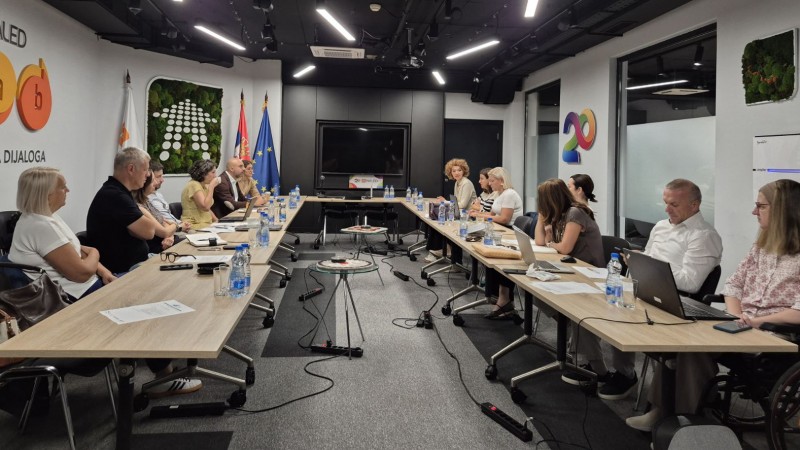
As part of the project, a two-day workshop with project partners was held on 10 and 11 September 2026 in Belgrade, at the NALED Lab premises. The workshop focused on exchanging experiences, improving operational procedures, and agreeing on the next steps in the implementation of the “Better Way” project.
During the first day, particular attention was devoted to the POS platform, including its functionalities, data management, and reporting. Participants discussed merchant application and verification procedures, data exchange with banks, monitoring of merchant status and turnover, analytics and data anonymisation, as well as the preparation of six-month reports and the subsidy payment process. The current status of the platform development in Bosnia and Herzegovina was also presented, alongside an exchange of experiences from Serbia.
Discussions also covered Programme management, including the work of the Programme Committee and Contact Centre, promotional materials, the responsibilities of project partners and banks, and the development of the project website in Bosnia and Herzegovina. The first day concluded with a session dedicated to reporting to GIZ.
On the second day, a meeting with institutional partners was held, followed by a GIZ session focused on reviewing the Action Plan and the next steps. A significant part of the workshop was dedicated to exchanging experience in the area of public-private dialogue, including the establishment and operation of public-private working groups, preparation of strategic frameworks and action plans, regulatory and economic analyses, public opinion surveys, and models for involving the private sector in public policy-making processes.
The workshop provided an important opportunity to align the activities of project partners, exchange practical experience, and define the next steps in implementing the project in Bosnia and Herzegovina, with a particular focus on the preparation of the POS Programme, institutional cooperation, and the development of measures aimed at expanding cashless payments.